domingo, 18 de agosto de 2013

How to Make Fresh Pasta


How to Make Fresh Pasta


Making pasta from scratch is easier than you may think. And not only will you be able to taste the difference in the finished product, you’ll also know exactly what ingredients went into it.

Here, we demonstrate two ways to make fresh pasta: by machine and by hand. The first is faster, but it requires special equipment; the second is a labor of love, ideal for a leisurely weekend or group activity. Either way, you’ll be rewarded with flavorful, slightly chewy strands made with just flour, eggs, olive oil and a pinch of salt — the perfect foundation for any pasta dish. Start with the basic recipe below, then read on for step-by-step 


instructions.

Egg Pasta
Makes 1 lb. (500 g.)

2 1/2 cups (12 1/2 oz./390 g.) unbleached all-purpose or “00 flour, plus more flour as needed
1/4 tsp. fine sea salt
4 large eggs, at room temperature
2 tsp. olive oil


Spaghettini with Summer
Squash & CrispySpeck

This recipe combines the sweetness of summer squash with the smokiness of speck. It is also gorgeous to look at: strands of thin spaghettini intertwined with bright green and yellow ribbons of squash and rosy flecks of ham.
Ingredients:
            Fine sea salt, to taste, plus 1/4 tsp.
            2 Tbs. extra-virgin olive oil
            4 oz. (125 g) Italian speck, cut into small dice
            3 garlic cloves, very thinly sliced
            1 lb. (500 g) mixed zucchini and yellow summer squash, sliced
  very thinly lengthwise using a mandoline or vegetable peeler,
  then cut into thin strips
            Freshly ground pepper, to taste
            2 Tbs. finely shredded fresh basil
            1 lb. (500 g) dried spaghettini
            1/2 cup (2 oz./60 g) grated Parmigiano-Reggiano cheese
Directions:
Bring a large pot of salted water to a boil over high heat.

Meanwhile, in a large fry pan over medium heat, combine the olive oil and speck and sauté until the speck is crispy, about 7 minutes. Add the garlic and sauté until it just begins to turn golden, about 3 minutes.

Add the squash and toss well to coat the strands with the oil. Season with the 1/4 tsp. salt and a generous grinding of pepper. Increase the heat to medium-high and cook until the squash is just tender, 3 to 4 minutes. Stir in the basil and remove from the heat. Cover the sauce to keep warm.


Add the pasta to the boiling water, stir and cook until al dente, about 9 minutes or according to the package instructions. Drain the pasta, reserving about 1/2 cup (4 fl. oz./125 ml) of the cooking water. Transfer the pasta to the pan with the sauce. Using tongs or a pasta fork, toss gently to combine. Add a splash or two of the pasta-cooking water to loosen the sauce, if needed. Sprinkle with the cheese and toss again. Season with salt and pepper.

domingo, 19 de mayo de 2013

Menú para un Domingo Bo Chef

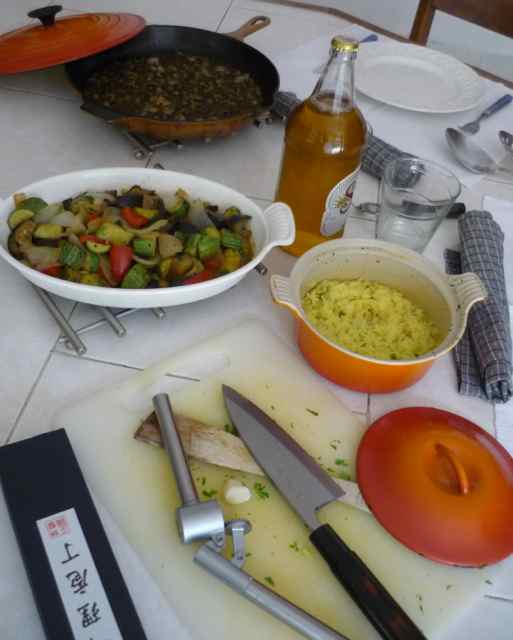
Menú para un Domingo Bo Chef Machaca con salsa de Zarzamora- Arroz con Cúrcuma – Ratatouille Rata tui Este platillo original de la región del mediterráneo , se puede combinar muy bien tanto con carne como con pescado ahora lo integramos a una receta mexicana como acompañamiento de la Machaca campestre. Machaca campestre . 100 gramos de machaca media cebolla finamente cortada medio poro un chile verde perejil y cilantro un diente de ajo. Ponemos a sazonar la cebolla y el ajo agregamos el poro Y una ves acitronado integramos la machaca y el perejil y cilantro finamente cortado Con el cuchillo “Deba Boucho” Una vez integrado agregamos vino para cocinar , media taza de agua y salsa de zarzamora A fuego lento tapamos y cocinamos por cinco minutos. Rata tui Cortar una cebolla a trozos grandes cuadrados, hacer lo mismo con la berenjena , la calabaza, y el pimiento morrón , Calentar el sartén y agregar un poco de aceite en donde poneos a freír el ajo , la cebolla Una vez acitronado agregamos el pimiento y la berenjena posteriormente la calabaza , hierbas de provece y sal. Tapar el sartén y cocinar a fuego lento , aumentar un cuarto de taza de agua . Ingredientes Una berenjena Una cebolla grande Un pimiento morrón Dos calabazas Un diente de ajo Arroz con cúrcuma El arroz se puede hacer de manera tradicional , solo aumentamos perejil y cúrcuma una vez que lo coloquemos a fuego lento y con tapa. BOCHEF 2013-05-19


sábado, 16 de marzo de 2013

"deba boucho"


BoChef El cuchillo se llama "deba boucho". Es muy filoso y pesa mucho. Esta creado para cortar el hueso del pescado , por ello el peso , esta calculado primordialmente para cortar con un filo espectacular para hacer "sashimi" De ahí sus finas lajas (pescado finamente cortado). Este filo que hay que cuidar en todos los aspectos no se pierde fácilmente pues el acero japonés es de un temple excepcional Sin embargo cuando llega el momento de afilarlo de nuevo Hay que hacerlo con una piedra especial y solo deslizarlo en un solo sentido y lado. Adjunto en la presente una foto de nuestra pesca.( Keiichi Tanaka ) El cuchillo "deba boucho" También se puede usar para cortar el hueso de pollo. Realmente una maravilla para la cocina Aquí presento un espagueti acompañado con salsa de perejil a la crema y lajas de salmón . Bo Chef Marzo2013-03-16 Keiichi Tanaka esta dedicado a la investigación del Arte Japonés en México , pero también es un gran pescador y cocinero japonés Aquí en la foto ha salido a pescar una buena dotación de besugos Que posteriormente compartirá con sus amigos Keiichi además de ser un buen amigo comparte conmigo el gusto del arte y la cocina BoChef

jueves, 3 de enero de 2013

Rosca de Reyes

Rosca de Reyes Ingredientes 600 gr de harina 12 gr de levadura en polvo 150 gr de azúcar 10 gr de sal 180 gr de mantequilla 150 ml de leche 30 ml de esencia de vainilla 1 naranja 6 huevos (1 para barnizar) 150 gr de acitrón 50 gr de azúcar para espolvorear 3 muñecos de plástico Para preparar la costra de dulce 200 gr de manteca vegetal 200 gr de harina 200 gr de azúcar glas 10 ml de esencia de vainilla 2 huevos Preparación

Mezclar la harina, la levadura, el azúcar, la sal y la naranja (en ralladura) para lograr una especie de masa a la cual, tendrás que verterle los huevos, un poco de leche y también algo de esencia de vainilla. Una vez que la masa este uniforme, hay que añadir mantequilla y un poco de leche. Amasa hasta lograr un cuerpo de consistencia elástica y coloca éste ya en un molde dejándolo reposar hasta que doble o aumente su volumen considerablemente. Después , comienza a darle forma a tu rosca extendiéndola con tus manos y aprovecha este proceso para introducirle un muñequito sorpresa. Para preparar las costras de dulce , haz una mezcla de manteca con azúcar y poco a poco ve incorporándole harina y algunas yemas de huevo. Después, bate hasta lograr una especie de pasta espesa la cual, deberás dejar reposar por unos instantes. Finalmente, barniza un poco la rosca con el último huevo y decora ésta con la pasta que, una vez lista, formará las costras de acompañando éstas con algunas piezas de acitrón cortado para lograr el diseño final de la Roscas de Reyes. Una vez lista tu rosca, espolvorea un poco de azúcar y deja hornear la pieza completa por aproximadamente 40 minutos, a una temperatura promedio entre 180 y 190°.

sábado, 10 de noviembre de 2012

Happy Thanksgiving Turkey

Soaking a turkey in a salt-and-sugar solution adds moisture to the meat. This is an especially good technique to use with all-white meat, which can become dry when roasted. Soaking the breasts after brining in fresh water prevents the meat from being overly salty, although it will be somewhat saltier than turkey that has not been brined. Keep this in mind when salting the gravy to keep the flavors of the dish in balance. Ingredients: For the brine: 6 quarts water 2 cups kosher salt 1 1⁄2 cups firmly packed light brown sugar 2 bone-in fresh whole turkey breasts, about 11 lb. total 9 Tbs. unsalted butter, at room temperature 1 yellow onion, unpeeled, quartered 2 large carrots, unpeeled, coarsely chopped 1 3⁄4 cups chicken stock or low-sodium canned chicken broth 1⁄2 cup dry white wine 1⁄4 cup peanut or canola oil 1 Tbs. fresh lemon juice For the gravy: 7 cups turkey stock 1⁄4 cup cornstarch 1⁄3 cup minced fresh flat-leaf parsley 1 Tbs. fresh lemon juice 1 Tbs. minced lemon zest Salt and freshly ground pepper, to taste To make the brine, in a stockpot, combine the water, salt and brown sugar. Place over medium heat and cook, stirring, just until the salt and sugar dissolve. Rinse the turkey breasts and pat dry. In 1 very large or 2 large glass bowls or other nonaluminum containers, cover the turkey breasts with the brine. Refrigerate, turning the breasts occasionally in the brine, for 24 hours. Drain and discard the brine. Cover the turkey breasts with fresh, cold water and let stand at room temperature, turning once or twice, for 4 hours. Drain and pat dry. Position a rack in the lower third of an oven and preheat to 325°F. Spread 1 1/2 Tbs. of the butter over each turkey breast. Place the breasts on a rack in a flameproof roasting pan. Scatter the onion and carrots in the pan around the turkey. Roast for 30 minutes. Meanwhile, in a small saucepan, combine the chicken stock, the remaining 6 Tbs. butter, the white wine, oil and lemon juice. Warm over low heat until the butter melts. After 30 minutes of roasting, baste the breasts with some of the stock mixture. Continue to roast the turkey, basting every 30 minutes with the remaining stock mixture and then with the accumulated pan juices, stirring the vegetables in the pan occasionally, until the breasts are well browned and an instant-read thermometer inserted into the thickest part of the breast registers 165°F, about 2 hours. Transfer the breasts to a cutting board and cover loosely with aluminum foil while you make the gravy. To make the gravy, place the roasting pan with the vegetables across 2 burners and turn the heat to medium-high. Add 6 3/4 cups of the turkey stock to the pan and bring to a brisk simmer. Stir to deglaze the pan, scraping up the browned bits from the bottom, about 5 minutes. Pour the contents of the pan through a sieve set over a large bowl, pressing hard on the vegetables with the back of a large spoon to extract all the liquid; discard the solids. Spoon off as much of the fat as possible from the liquid, or pour the liquid into a fat separator and pour off the liquid. Transfer the liquid to a wide saucepan. Place over medium-high heat and simmer briskly until reduced by one-fourth, about 10 minutes. In a small bowl, stir the remaining 1/4 cup stock into the cornstarch to make a slurry. Gradually stir the slurry into the saucepan. Stir in the parsley, lemon juice and lemon zest. Cook until the gravy clears and thickens, about 1 minute. Season with salt and pepper. Slice the turkey breast against the grain, on a slight diagonal, and serve with the gravy. Serves 8 to 10.

viernes, 17 de agosto de 2012

Serve as a first course or as a light lunch accompanied by a tossed green salad. Ingredients: 8-oz. cylinder goat cheese (chèvre), with a slightly creamy texture 1 cup Spanish or other olive oil, plus more for brushing Salt and freshly ground pepper, to taste 2 fresh thyme sprigs 12 plum tomatoes, quartered 2 garlic cloves, thinly sliced Fresh baguette slices or crostini for serving Directions: Carefully unwrap the cheese so it retains its cylindrical shape. Cut the cheese into 1/2-inch-thick rounds. In a shallow bowl or lidded container, pour in 1/4 cup of the olive oil to evenly coat the bottom. Season lightly with salt and pepper. Place the cheese slices in the oil about 1/2 inch apart. Season the cheese with salt and pepper, drizzle with 1/4 cup of the olive oil and place the thyme sprigs on top. Wrap tightly with plastic wrap or cover with the lid. Set in a cool, dry place or refrigerate for at least 2 hours or as long as overnight. Meanwhile, preheat an oven to 350°F. Arrange the tomatoes on a wire rack set on a baking sheet. Brush the tomatoes lightly with olive oil and season with salt and pepper. Roast until the tomatoes are lightly golden and most of their juices have evaporated, about 1 hour. Let cool to room temperature. In a small fry pan over medium heat, warm the remaining 1/2 cup olive oil. Add the garlic and fry, stirring occasionally, until tender and translucent, 2 to 3 minutes. Remove from the heat and let cool. In a bowl, toss the tomatoes with the fried garlic and oil, and season with salt and pepper. Transfer the tomatoes and marinated cheese to a shallow serving bowl or divide among several small cazuelas. Serve with a basket of baguette slices alongside. Serves 6.
Servir como primer plato o como un almuerzo ligero acompañado de una ensalada verde. ingredientes: 8-oz. queso de cabra cilindro (chèvre), con un    textura ligeramente cremosa 1 taza de español o de aceite de oliva otros, y más para    cepillado Sal y pimienta recién molida, al gusto 2 ramitas de tomillo fresco 12 tomates, cortados en cuartos 2 dientes de ajo, en rodajas finas Rebanadas de baguette fresco o crostini para servir Instrucciones: Desenrolle cuidadosamente el queso para que conserve su forma cilíndrica. Cortar el queso en rodajas 1/2-inch-thick. En un recipiente poco profundo cuenco o con tapa, vierta 1/4 taza de aceite de oliva para cubrir la base. Sazone ligeramente con sal y pimienta. Colocar las lonchas de queso en el aceite de aproximadamente 1/2 pulgada. Sazonar el queso con sal y pimienta, rociar con 1/4 taza de aceite de oliva y colocar las ramitas de tomillo en la parte superior. Envuelva bien con papel de plástico o la tapa con la tapa. Situado en un lugar fresco, seco o refrigere por lo menos 2 horas o durante toda la noche. Mientras tanto, precalentar el horno a 350 ° F. Colocar los tomates en una rejilla de alambre situado en una bandeja para hornear. Cepille los tomates con un poco de aceite de oliva y sazone con sal y pimienta. Asar hasta que los tomates estén doradas y la mayor parte de sus jugos se hayan evaporado, aproximadamente 1 hora. Dejar enfriar a temperatura ambiente. En una sartén pequeña a fuego medio, caliente el aceite restante 1/2 taza de oliva. Agregue el ajo y freír, revolviendo ocasionalmente, hasta que estén tiernas y translúcidas, de 2 a 3 minutos. Retirar del fuego y dejar enfriar. En un tazón, mezcle los tomates con el ajo frito y aceite, y sazonar con sal y pimienta. Transfiera los tomates y el queso marinado en un recipiente poco profundo porción o dividir entre varias pequeñas cazuelas. Sirva con una canasta de rebanadas de pan al lado. Rinde 6 porciones.

Slow-Roasted Tomatoes

If you’ve never tried slow-roasting tomatoes, now is your perfect opportunity. Summer’s ripe heirlooms and Early Girls are at their sweetest, and while they are flawless eaten fresh with a sprinkle of sea salt and olive oil, roasting adds an entirely new dimension of flavor. Roasting tomatoes concentrates their sweetness, caramelizing the natural sugars and lending a deep richness to the end result. Prep time is minimal but the tomatoes take a bit of time in the oven, so plan to roast them when you have a few hours of down time at home. You’ll be rewarded with a prized ingredient for your next dish — or, if you’re like us, a snack that’s hard to beat just as is.
Slow-Roasted Tomatoes 8 to 10 plum or 2 cups cherry tomatoes, halved lengthwise About 1/4 cup extra-virgin olive oil About 1 tsp. sugar 2 cloves garlic, thinly sliced Sea salt and ground pepper Preheat oven to 300 degrees F. Lightly oil a rimmed baking sheet. Arrange tomatoes, cut side up, on prepared baking sheet. Drizzle with olive oil and sprinkle evenly with sugar, garlic and generous amounts of salt and pepper. Roast tomatoes until deep red and wrinkled, 2 to 2 1/2 hours for medium or plum tomatoes and 1 hour for cherry tomatoes. Remove from oven and let cool on baking sheet. Serve warm or at room temperature. Serves 4 to 6. Si usted nunca ha intentado lento asar los tomates, ahora es tu oportunidad perfecta. Herencias maduras de verano y las niñas prematuros se encuentran en su más dulce, y si bien son impecables consumo en fresco con una pizca de sal marina y aceite de oliva, el tostado, añade una dimensión completamente nueva de sabor. Tostación de concentrados de tomates de su dulzura, caramelizar los azúcares naturales y dando una profunda riqueza que el resultado final. Tiempo de preparación es mínimo, pero los tomates tomar un poco de tiempo en el horno, por lo que planea para asar cuando usted tiene un par de horas de tiempo de inactividad en el hogar. Usted será recompensado con un ingrediente preciado para su siguiente plato - o, si eres como nosotros, una merienda que es difícil de superar tal como es. Slow-pesto de tomates 8 a 10 ciruelas o 2 tazas de tomates cherry cortados a la mitad longitudinalmente Alrededor de 1/4 de taza de aceite extra virgen de oliva Alrededor de 1 cdta. azúcar 2 dientes de ajo, en rodajas finas La sal marina y pimienta molida Precaliente el horno a 300 grados F. Engrase ligeramente una bandeja para hornear con borde. Organizar los tomates, la parte cortada hacia arriba, sobre una bandeja para hornear preparada. Rocíe con aceite de oliva y espolvorear uniformemente con las cantidades de azúcar, ajo y generosa de sal y pimienta. Tomates asados hasta de color rojo oscuro y arrugado, de 2 a 2 1/2 horas para los tomates medianos o ciruela y 1 hora para los tomates cherry. Retire del horno y dejar enfriar en una bandeja para hornear. Servir caliente oa temperatura ambiente. Para 4 a 6.